
CIS Benchmarks
Center for Internet Security secure configuration standards for servers, databases, containers, cloud, and networking.
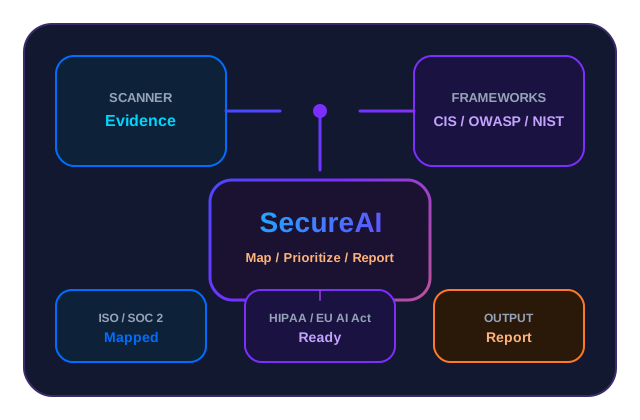
CIS Benchmarks are detailed recommendations for configuring infrastructure securely. Think of them as a security checklist for your stack: user accounts, SSH, firewalls, logging, file permissions, and services. SecureAI maps scanner evidence to CIS-style hardening themes so misconfigurations show up clearly in reporting.
SecureAI mapped themes
- Authentication hardening
- Least privilege
- Network exposure
- TLS
- Audit logging
Why CIS matters for AI systems
When you run AI on your own infrastructure, CIS becomes an AI data-security concern. An AI SaaS stack may hold customer data, RAG documents, embeddings, API keys, conversations, prompts, uploaded files, and database credentials. A weak server, container, or database config can turn into an AI data breach.
What is at risk
- Customer & personal data
- RAG documents & embeddings
- API keys & credentials
- Conversations & prompts
- Uploaded files & internal APIs
Security in layers
For an AI SaaS, CIS works best as layered hardening: OS/server first, then containers, then orchestration, then cloud. Each layer has its own CIS Benchmark family.
Typical layers
- Layer 1: OS / server (e.g. Ubuntu, Debian)
- Layer 2: Docker & containers
- Layer 3: Kubernetes (EKS, AKS, GKE)
- Layer 4: Cloud provider & services
- Plus databases, apps, and APIs
CIS + AI Security Auditor
CIS provides the security baseline. SecureAI evaluates infrastructure evidence against those themes. AI can then explain findings, prioritize risk, and guide remediation, instead of forcing teams to read a 300-page checklist manually.
Auditor flow
- CIS rules as the baseline
- Server / stack scanning
- Risk analysis & scoring
- Clear report for teams
- Guided remediation
CIS Benchmark is not a certification
Following a CIS Benchmark means you configure technology to a recognized security baseline. It does not mean your company is "CIS certified." SecureAI mapping supports reporting and prioritization; it does not replace CIS-CAT assessments, audits, or formal certification.